In
early 1937, during the midst of Joseph Stalin's ruthless purges of the Red
Army, the German Security Police chief Reinhard Heydrich planned an intelligence
operation to further weaken the Red Army High Command. Acting on information
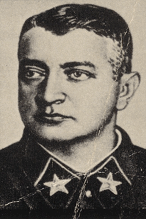
that Marshal Mikhail Nikolayevich Tukhachevsky, the Soviet Deputy Commissar
for War, planned to carry out a coup against Stalin, Heydrich hoped to tip
off the Soviet "Boss" thus ensuring the destruction of the senior leadership
of the Red Army. Enlisting the aid of two SD subordinates, Alfred Naujocks
and Dr. Hermann Behrends, Heydrich obtained the signature specimens
of several Soviet generals and forged documents that stated Marshal Tukhachevsky's
intention of carrying out the coup. Behrends carried the forged documents
to Prague and, acting through the President of Czechoslovakia, sold
the forgeries to Soviet agents. The forgeries, combined with "evidence"
already given by previously arrested Red Army officers, led to the arrest
of Marshal Tukhachevsky. After confessing to being "German spies," Tukhachevsky
and seven other Soviet generals were executed on 11 June 1937 following
a summary trial. Although Heydrich boasted of destroying the Red Army High
Command, the role of the German Security Police in the affair was of no
real consequence. Stalin had long-since planned to liquidate Tukhachevsky
and, indeed, Heydrich's initial notification of Tukhachevsky's coup proved
to be false information conveniently provided by a Soviet secret agent.
 |
 |
|
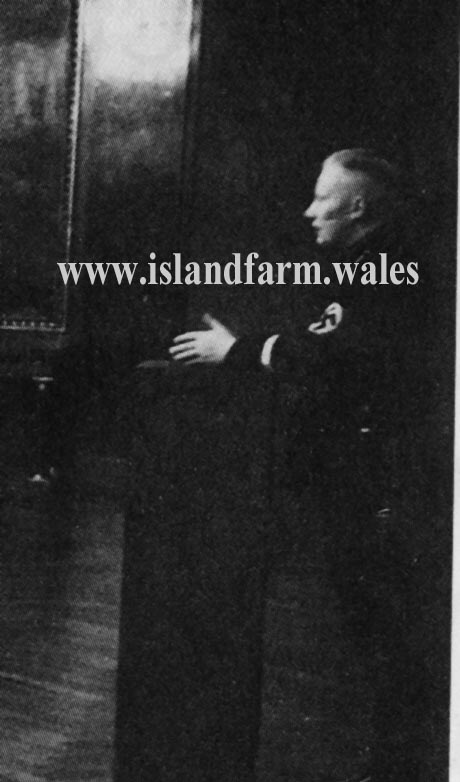
SS-Obergruppenführer
und General der Polizei Reinhard Heydrich, Chief of the Security Service
or SD, and Behrends' boss when he served in that organization (see
mention of Heydrich in "The Tukhachevsky Affair").
Note the "SD" diamond on Heydrich's left sleeve. |
Soviet
Marshal Mikhail N. Tukhachevsky
|
 |
 |
|
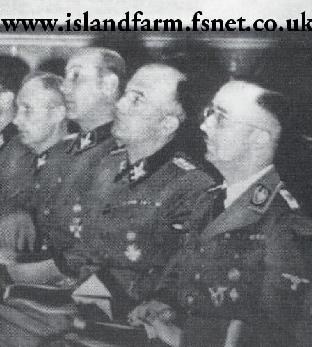
The
officers in the photo are (left to right):
SS-Brigadeführer Dr. Hermann Behrends SS-Brigadeführer Hans-Adolf Prützmann SS-Brigadeführer Ludolf von Alvensleben Reichsführer-SS Heinrich Himmler |
On the 17th June 2001 I was fortunate to meet Hinrich Behrends (son of Hermann Behrends). I showed him and his wife (Doris) around Hut 9, showing them the rooms, the paintings on some of the walls within the rooms and the escape tunnel entrance.
 |
|
Hinrich,
Myself (Brett Exton) and Doris
Outside Hut 9 Sunday 17th June 2001 |
He then allowed me to copy these photos, I am extremely grateful to Herr Hinrich Behrends for allowing this.
 |
|
Hermann
Behrends holding his son Hinrich
Behrends
(Aged 3) in 1938. |
 |
|
Hermann
Behrends (back row 2nd from right)
|
 |
|
Postwar Prosecution:
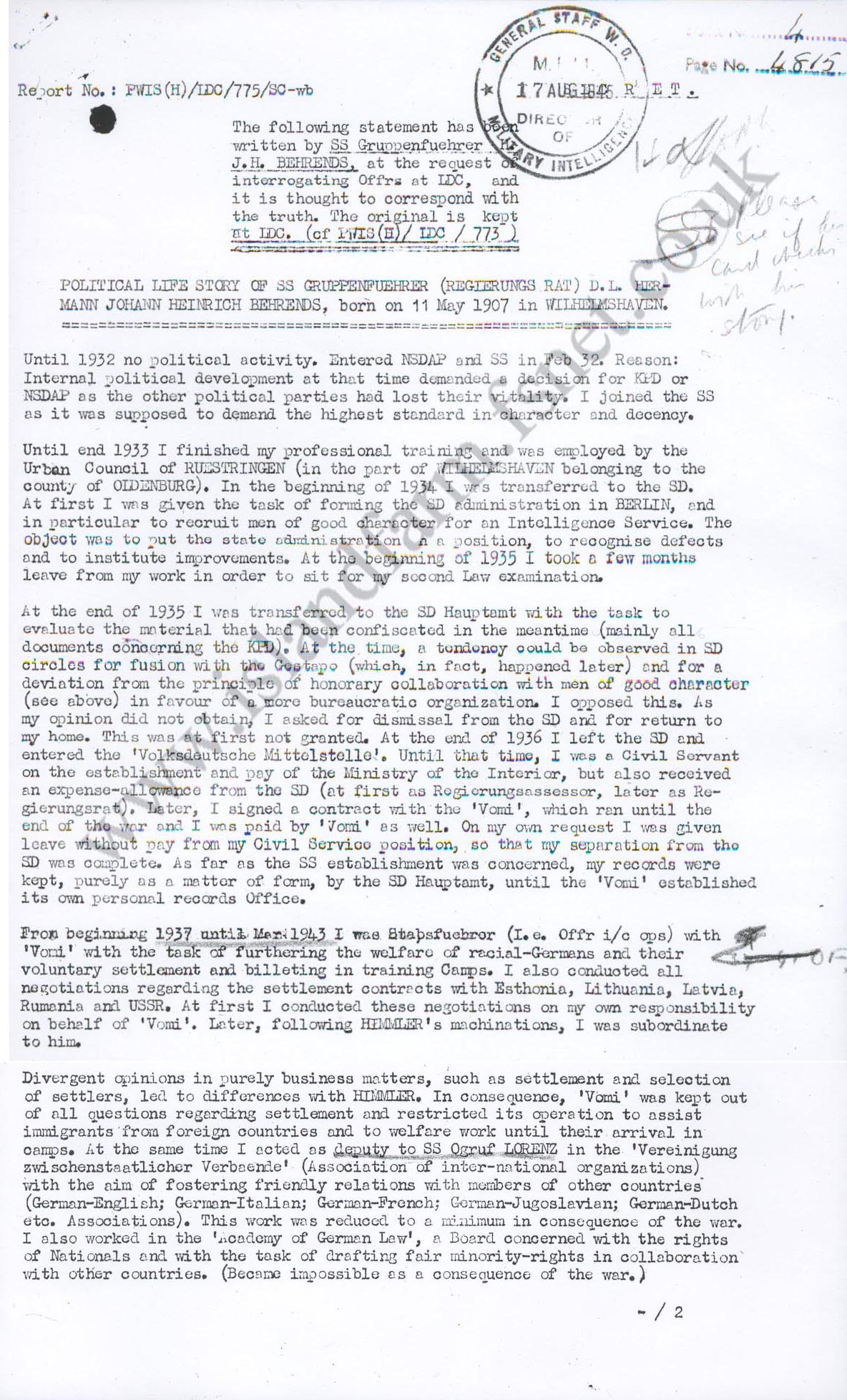
Captured in Flensburg on 5 July 1945 following his voluntary surrender to the British authorities. Transferred to Great Britain and interrogated at the London District Cage in August 1945
 |
 |
 |
 |
|
Annotated
version of the original (hand written) interrogation report.
|
Page
1
The original (hand written) interrogation Report. |
Page
2
The original interrogation Report. |
Page
3
The original interrogation Report. |
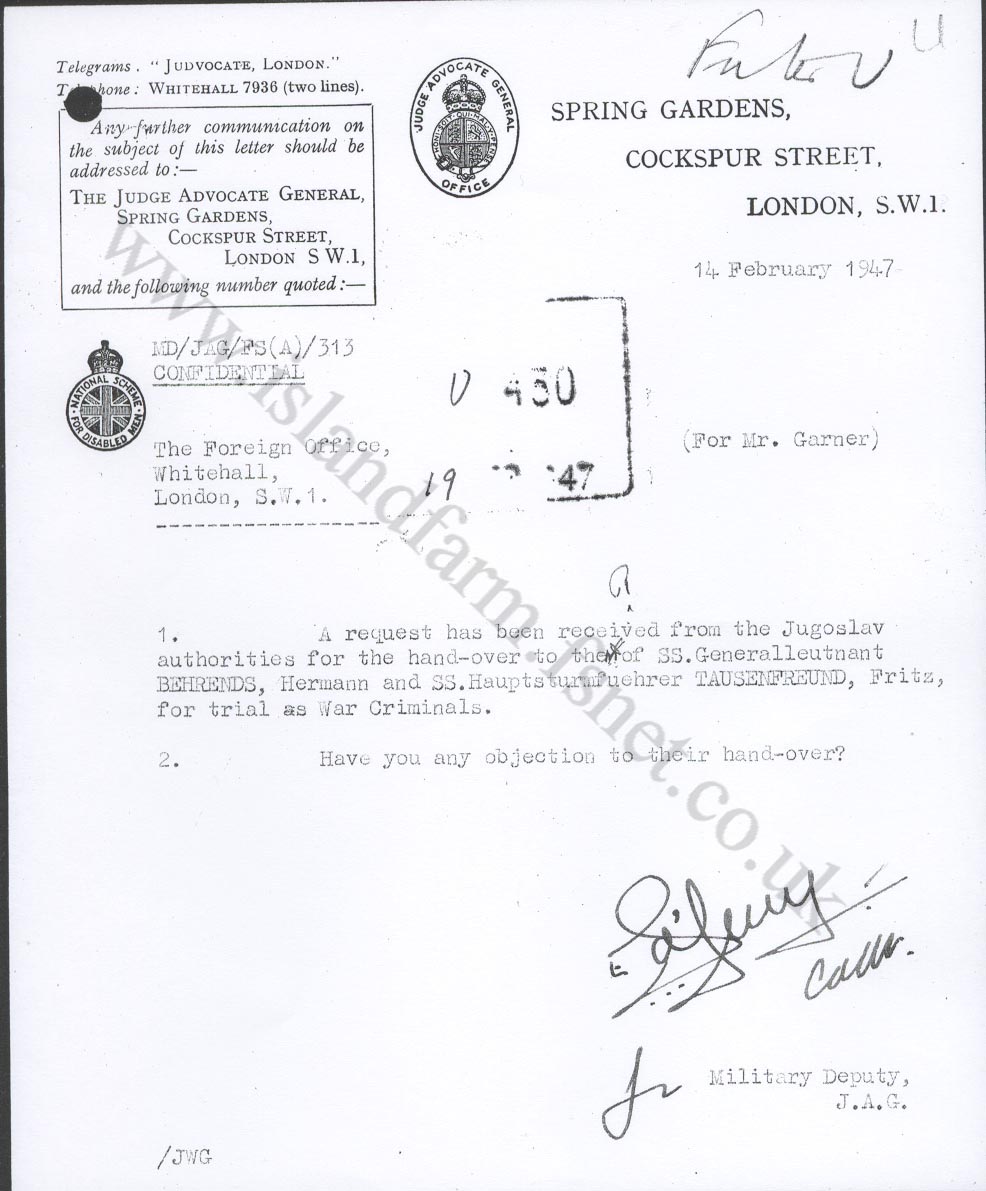
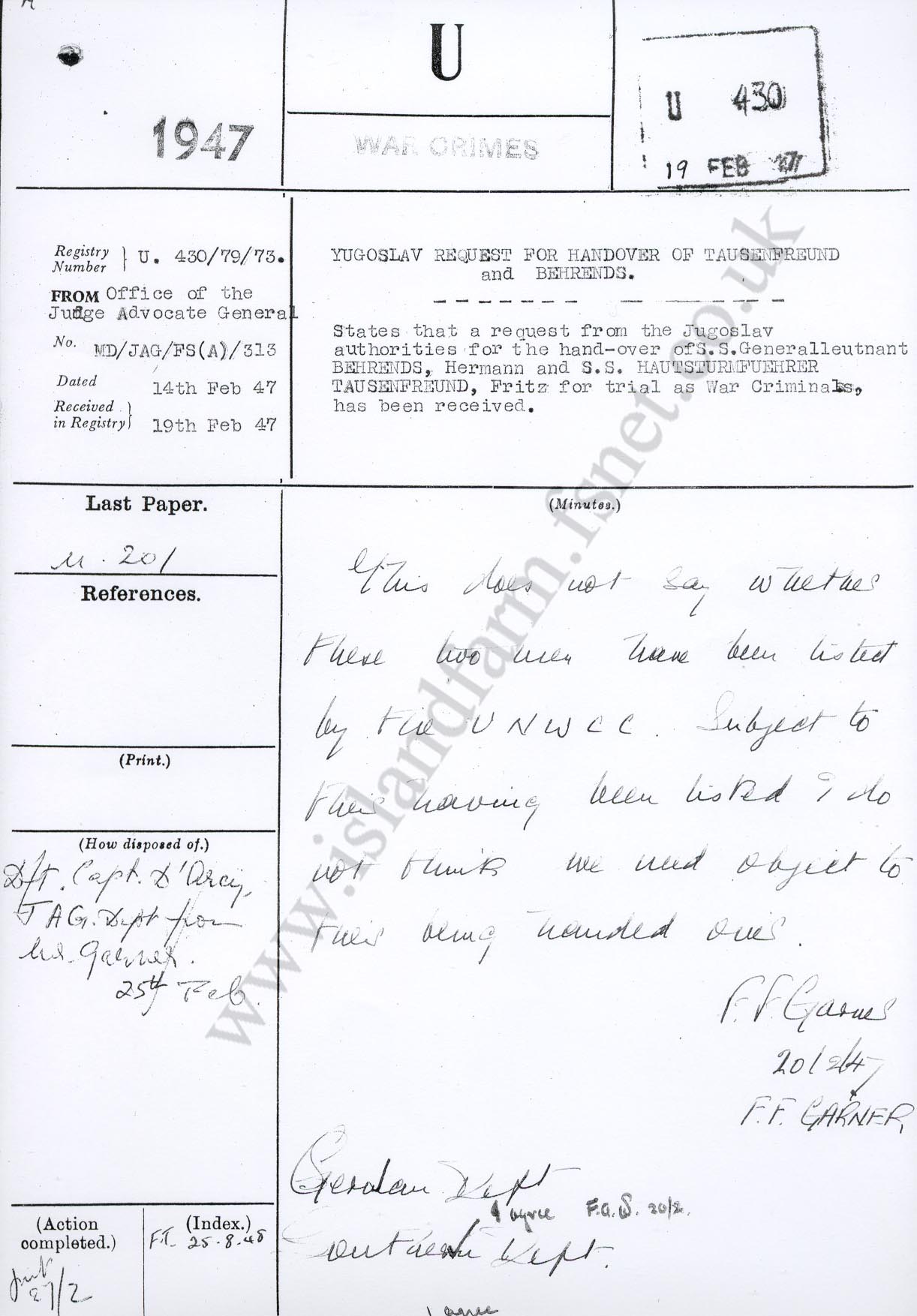
Interned at Island Farm Special Camp 11, Bridgend, South Wales until Yugoslavia requested his extradition as a war criminal in February 1947.
 |
 |
|
The
original British extradition request memoranda for Behrends
and SS-Hauptsturmführer Fritz Tausenfreund (February 1947)
|
Temporarily imprisoned in the SS and Nazi Officials holding camp at Neuengamme in Germany, Behrends and other German generals were transported by truck to Yugoslavia. Tried and convicted by a Yugoslav court for war crimes, he was sentenced to death by firing squad in Belgrade and buried in an unmarked mass grave. Numerous sources cite widely conflicting dates for his death ranging from 1946 to 1948, however, the above extradition request from the Yugoslavian Authorities was made in February 1947 and also Hinrich Behrends, the General's son, recalled:
"The
date of his death is definitely 20/21 December 1947. We know this
from a letter which was smuggled out of his cell by a comrade
who was sent back to Germany and who witnessed when he was taken
out that night and confirmed that next morning one of the guards
wore his coat and another one his wedding ring. In the [existing]
literature, 1948 is sometimes mentioned but wrongly so.
The last letter of my father written after the death sentence
was later smuggled out of the prison and handed to my mother,
who at a later age, before she moved into a nursing home, destroyed
all personal correspondents. However, the content is deeply engraved
in my memory. In coded terms he first talks of the difficult time
ahead of him and then expresses disappointment without clearly
stating about what. There is speculation that it might be with
the Third Reich system, his comrades or false promises made by
the British and or Yugoslavs. It being a good bye letter he then
endorses every decision my mother would take to bring up the children.
I think by that he also meant remarriage. It is followed by advice
to each individual child, in my case he said I am a fast learner,
who should watch out not to become superficial. He then asked
to convey to his mother how grateful he was for his upbringing
and ensures her, that he had never done any harm to anybody. Somewhere
at the side of this letter the date 20/21st of December was written
with a cross attached to it.
......The
Jugoslawien government had requested the British government to
extradite him to Belgrad. This was adhered to and he was sent
to the German camp Neuengamme to be collected by the Jugoslawe.
Being in Neuengamme he was offered by comrades to flee through
a tunnel ( yet another one!) which however he refused on the grounds
that nothing could happen to him since he had not committed any
crime including also his 6 month stay in Belgrad as HSSPF in 1944.
He was then taken by lorry together with other generals transferred.
On their way through Germany another opportunity to flee apparently
arose. He refused again this not wanting to leave some of his
older comrades on their own. In Belgrad he was then put on a show
trial -and I deliberately use this term - since it happened according
to literature to many generals and others who served during the
war in Jugoslawia.
..... We still to date don't know any details about this trial
since officially we have never been informed about it and otherwise
hardly got any information. All we know that he was sentenced
to death by shooting on the grounds - and this was the only reasons
- to have belonged to the SS. The execution together with other
generals was carried out on the night of the 20 to 21st. December
1947. The means of the execution must have been the usual gruesome
ones i.e. mistreatment, use of machine gun, unknown mass grave
etc.
...As a sideline I vaguely remember Werner Lorenz for two reasons: Firstly he drove a big impressive car and as a car freak even in my youngest days I was most intrigued by it. Secondly, I still remember when my father, to my great astonishment, greeted him first at one occasion when I was present, something I was not used to since he was normally greeted first.
....I remember to have been to Werner Lorenz's house two or three times and was most intrigued by the great number of most beautiful and valuable toys I was allowed to play with. I like to add today it would be different ! In addition in order not to be spoiled we only had a limited number of toys at home.
...Two other names that I still remember are Pohl and Radunsky. The latter I remember vividly for the following reason: When the air raids on Berlin became unbearable the family and other VOMI member families were evacuated to a place in the country outside Berlin. From there we had eventually to flee the Russians and our father insisted that we would not get any special treatment and would leave like any other ordinary people. So we were given a small car the engine of which was not working and had always to look out for a truck to pull us. We could hardly take any personal belongings with us and I even had to sit on the mud flap since there was insufficient room in the car for all family members. Radunsky however took an Opel Admiral, one of the biggest cars at the time loading of all kind of valuables. This struck me as very odd at the time even just being ten years old.
(Lorenz-Oswald Pohl: Pohl's organization was, among other things, in charge of administering the concentration camps. Although VOMI accepted large amounts of clothing from Pohl's office (confiscated from murdered Jews), it appears Himmler wanted a closer cooperation between VOMI and Pohl. It would seem that Lorenz, realizing what Pohl's office was in charge of, attempted to keep his cooperation to a minimum.)
Hinrich Behrends also recalled seeing his father wearing Prinz Eugen cuff titles and his mother mentioning the division. However, no service record ever lists Hermann Behrends with this division. The following is a theory, by Shawn Bohannon, which might explain this:
"The
book "Himmler's Bosnian Division," the first-ever complete history
of the "Handschar" Division, clearly states Behrends was a battalion
commander in the divisional artillery regiment for the same basic
time period indicated in Behrends' service record. Although the
service record does not indicate he was ever in the "Prinz Eugen"
Division, I can only suggest he spent some reserve training time
with this division in addition to his VOMI duties in Yugoslavia.
A large selection of German and ethnic German officers and NCOs
were transferred from "Prinz Eugen" to help build the new "Handschar"
Division. Many of these men were not very pleased with this assignment
and continued to wear their old divisional cuff titles (mentioned
by you). At the end of the war, Tito paid "special attention"
to those German "Handschar" Division officers and NCOs who had
led his fellow countrymen against him. "
Click here to see a photo of SS-Gruppenfuhrer und Generalleutnant der Polizei Hermann Behrends in the company of fellow prisoners of war at Island Farm
SEE
NEXT PAGE FOR HERMANN BEHRENDS' BOSS