60th Anniversary Of D-Day
Beaches Of Normandy
POINTE DU HOC
Note: Although commonly known as Pointe du Hoc it is given as the Pointe de Hoe in American official accounts.
This forbidding spur of land was considered by the Germans to be virtually unassailable from the beach because of its steep 100-foot-high cliffs and 25-yard-wide beach beneath.

|
| On the clifftop a German soldier checks his range. |
The clifftop affords a commanding view of both Utah Beach in the west and Omaha to the east. Enemy long-range artillery on the point could direct deadly fire onto either shore. The Allies considered it a key defensive strongpoint which had to be taken out.
A special task force of two Ranger battalions, trained in cliff assaults, was selected to silence the German guns. They used rocket guns which fired rope grapnels to the tops of the cliffs and extension ladders borrowed from the London Fire Brigade.
The plan called for the first wave of three companies, consisting of 225 men of the 2nd Rangers led by Lieutenant-Colonel James E. Rudder, to land at the same time as the main D-Day American assault. A fourth company, Charlie Company, would land at the westernmost point of Omaha and capture the German strongpoint at Pointe de la Perceé, then advance to cover the flank of the Pointe du Hoc landing. The remaining two companies and the whole of the 5th Rangers formed the second wave.
If the first landing at Pointe du Hoc succeeded, they would land there and advance inland towards Isigny as the western flank of the whole Omaha assault. If the first landing failed, they would reinforce Charlie Company on Omaha Beach and take the Pointe du Hoc from the landward side.
On D-Day the landing crafts carrying Rudder's 225 men were forced eastward with the current towards Pointe de la Perceé, and their landing on the tiny beach at Pointe du Hoc was delayed by forty minutes. Hearing nothing, the remaining Rangers led by Lieutenant-Colonel Max Schneider assumed the assault had failed and landed at Omaha, where they joined in with the 116th Infantry.
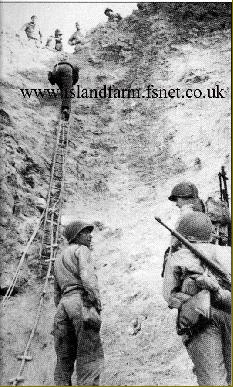
Displaying raw courage, the Rangers came ashore with fire support from the destroyers USS Satterlee and HMS Talybont, and climbed the Pointe du Hoc under German fire, with the first troops reaching the top in under five minutes.
|
| Rangers climb the cliffs at Pointe du Hoc. |
Only a handful of men were lost, and the Germans gave ground once the Rangers were on the clifftop. To their surprise, they found that the casemates, partly wrecked by repeated Allied air and naval bombardment, were empty. The French Resistance had been unable to get the information to London that the guns had not yet been installed.

|
| Rangers reach the clifftop. |
The force then gradually advanced inland where two Rangers spotted the well-camouflaged 155mm gun battery, now positioned south of the point and sitting mysteriously silent. With the enemy gun crews close by, the two men employed thermite grenades and destroyed the guns. At the end of the day, Rudder sent a message to V Corps saying: "Located Pointe du Hoc - mission accomplished - need ammunition and reinforcements - many casualties".
For two days, until being relieved on the 8th June, the small force held out alone against increasingly aggressive enemy counter-attacks. By the time the Rangers were relieved by V Corps units, only 90 combat-effective men of the original 225 remained. Casualties on D-Day had been about 40 men, with the other 95 occurring over the next two days. Rudder, who was wounded twice, was decorated for his achievement.
|
|
|
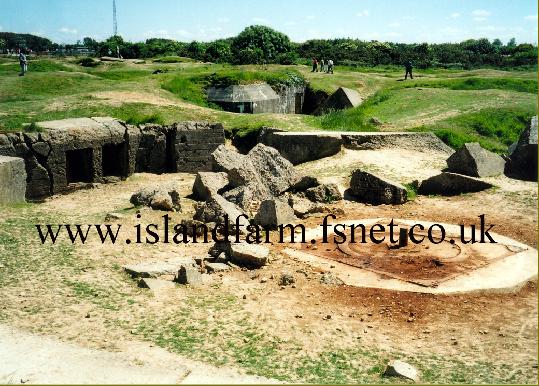
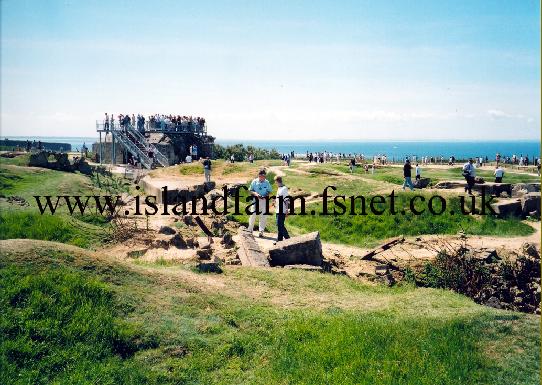
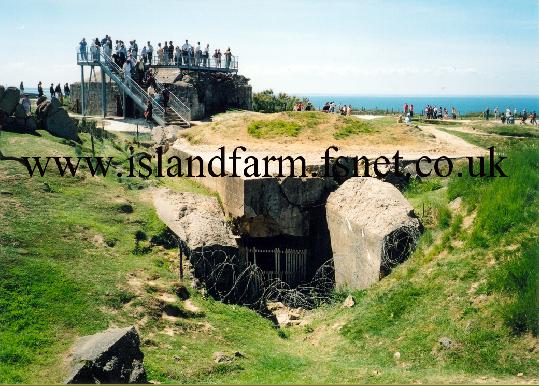
| Pointe du Hoc as it is today. Click Image to enlarge | ||
Sources:
- Badsey, Stephen. D-Day The Illustrated History. Colour Library Books Ltd, Godalming Surrey, 1994.
The Rangers: The US Army’s Rangers were founded in May 1942 at the instigation of General Marshall, based on the British Commandos and named after Rodgers’ Rangers, the irregular American raiders of the French and Indian War. The 1st Ranger Battalion under Major W.C. Darby, trained by the British at their Commando school, proved a success in raiding operations, and a few of its men fought with the Commandos at Dieppe. In early 1943, the Rangers were expanded to six battalions, two for the Mediterranean, two for the Pacific, and two for Europe, in order to provide a spearhead force for major amphibious assaults. A battalion designated 29 Rangers was also formed from 29th Infantry Division to continue the raiding tradition.