60th Anniversary Of D-Day
Beaches Of Normandy
Port En Bessin:
Port en Bessin was the actual linkup point between the American and British forces on June 7, 1944. The American 16th Infantry Regiment had landed on the Easy Red Sector on Omaha Beach and fought its way along the coastal towns to link up with the 47th Royal Marine Commandos, which had struggled its way from Gold Beach. The Royal Marines fought a difficult battle to take the town and its eastern and western fortifications. The Royal Marines finally took the town after fighting house-to-house and knocking out the harbour defences, which included pillboxes and a flak boat of the German Navy. The 16th Infantry Regiment took the part of town called Huppain and liberated the area now known as the Omaha Beach Golf Club.
After the town’s liberation, Port en Bessin/Huppain became a minor PLUTO Port. Large oil storage facilities were built near where the golf club is now located and tankers would offload their oil through pipelines at the harbour. In addition the port was expanded to handle 1,000 tons of cargo daily and was vital to the Allied effort until the Mulberry Harbours were built at Arromanches and Omaha Beach.
Pluto Origins:
A reliable supply of petrol for the advancing Allied forces following the D-Day landings was of the highest priority. Planners knew that the future invasion of Europe would be the largest amphibious landing in history and without adequate and reliable supplies of petrol any advance would at best slow down and at worst grind to a halt. A loss of momentum could jeopardise the whole operation as German forces would have time to regroup and counter-attack. Conventional tankers and 'ship to shore' pipelines were in danger of cluttering up the beaches, obstructing the movement of men, armaments and materials and, in all circumstances, were subject to the vagaries of the weather and sea conditions and they were easy targets for the Luftwaffe.
The idea of a Pipe Line Under The Ocean, (the English Channel), was an innovative solution. It was known that oil storage facilities located near the English Channel would be vulnerable to attack by the Luftwaffe. To reduce the risk of losses, a network of pipelines was already under construction. This was designed to carry fuel from safer storage and port facilities around Bristol and Liverpool to the English Channel. This network would later be linked to the planned pipeline at Skanklin on the Isle of Wight and Dungeness further to the west. The terminals and pumping stations were heavily disguised as bungalows, gravel pits, garages and even an ice cream shop!
Soon after D-Day, a continuous flow of petrol to meet the heavy demands of the liberation armies and air fleets was maintained by the 'Pipelines Under the Ocean'. These pipe-lines were vital arteries, which enabled the Allied Air Fleets and Land Forces to maintain the vital momentum needed to secure victory. Moreover Operation PLUTO made it possible to dispense with the fleets of tankers, which otherwise would have been necessary and spared them the ordeal of concentrated enemy attacks in congested waters, thus undoubtedly saving many hundreds of gallant lives.
Recommended website: Pluto - Pipeline Under The Ocean
|
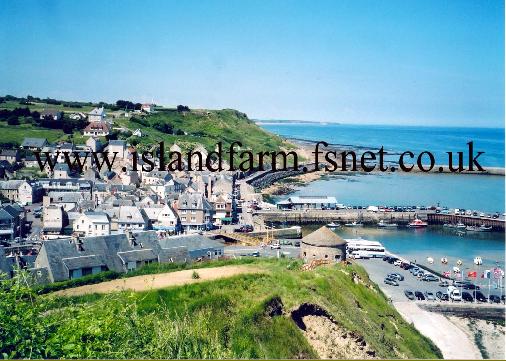
| View from a cliff top vantage point over looking the harbour town of Port En Bessin. In the distance is Omaha Beach and Pointe du Hoc. Click Image to enlarge |
OMAHA BEACH:
 |


|
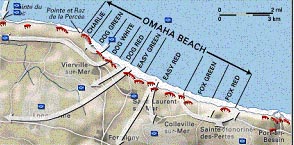
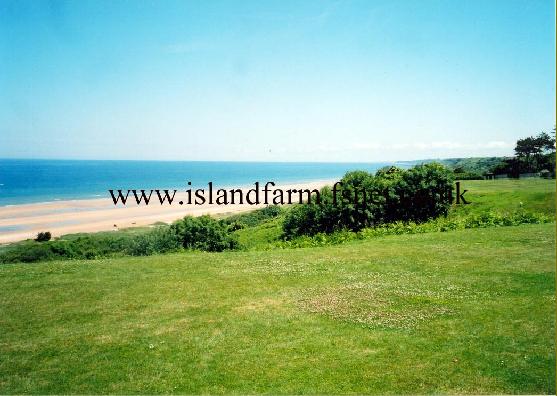
| View looking left towards "Fox Green & Fox Red" sectorsClick Image to enlarge | View looking north. Red ring (with two people inside) indicates perspective.Click Image to enlarge | View looking east towards ArromanchesClick Image to enlarge |
Not expecting a big opposition at Omaha, the 1st Infantry Division (also known as the Big Red One) and the 29th Infantry Division were given ambitious objectives. By nightfall on D-Day they were to secure an area 6 miles deep and nearly 18 miles long from the base of the Vire estuary at Isigny eastwards almost to Bayeux. What the Americans did not know was that the German 352nd Infantry Division had come forward to reinforce the 716th Static Division and many of its troops were dug in along the bluff, which rises to 170 feet and dominated the landing beaches. Between the sand of the beach and the bluff lay a strip of shingle impassable to vehicles, and the only exits from the beach were five draws or gaps in the bluff, all easily defended. To further add to the American's problems, bad weather forced many aircraft to bomb by using instruments only, missing targets. German batteries left naval gunners without a target, and in several places the final rocket salvoes fell short. This was a recipe for disaster.
The first assault troops, 16th Regimental Combat Team and 116th Regimental Combat Team, ran onto the beaches at 6:30am. Some DD tanks (duplex drive) launched from 6,000 yards offshore sank like stones. Nearly all the 105mm guns and most armoured tankdozers also went down. At least ten infantry craft floundered and underwater obstacles ripped others apart. Survivors were pulled eastward by the current, putting troops ashore up to two miles out of position. Within minutes of landing, the entire first wave was pinned on the beach.
Confusion grew as radios and signalling equipment were lost in the surf. At 09:00, Bradley considered abandoning Omaha altogether. American and British naval destroyers ran in so close they almost beached themselves to blast German pillboxes. A hit from the battleship USS Texas silenced a heavy German battery. Just after 10:00, the second wave landed, and before noon the battle swung in the American's favour.
The troops at "Bloody Omaha" had done an incredible job, but the landing remained precarious. Lacking guns and tanks, progress inland was slow. By nightfall, 116th Infantry and 5th Rangers held a position about 1,000 yards inland from Vierville. Official American accounts admit that casualty estimates for Omaha are little more than guesswork, but suggest between 2,000-3,000 men became casualties.

|
|
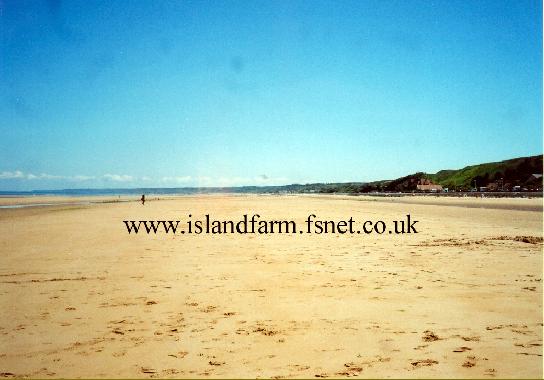
| Looking west on Omaha Beach - Dog Green SectorClick Image to enlarge | Looking east on Omaha Beach - Dog Green SectorClick Image to enlarge |
| When I was on the beach, one of the first things that became apparent to me, was how exposed you were. It was all too easy to imagine a German sniper or a machine gunner sat on the top of the hill firing down... |