International Military Tribunal at Nürnberg (Nuremberg)
Foreword: There isn't much point in my writing a detailed description of events at Nuremberg, because there are enough web sites out there which already do this. However, because e.g. von Rundstedt attended the Nuremberg Trials I thought it relevant to include a small summary.
On 14 November 1945, the proceedings of the International Military Tribunal at Nürnberg (Nuremberg) were opened. The twenty-four accused, whose number was later reduced to twenty-two by disease and death, among the top officials of the National Socialist Party, the top leadership of the armed forces and of the state administration of the defeated German state, were confronted with three classes of accusations:
- Crimes against peace;
- War crimes in a more restricted sense, e.g., violations of the laws and customs of war;
- Crimes against humanity.
Nine months later, twelve of the defendants were indeed condemned to death on the basis of two or more of the charges, three were set free, and the remainder was sentenced to prison terms of varying duration. Controversy was aroused among jurists and the general public alike, above all in regard to the validity and treatment of points (1) and (3).
For the epoch-making International Military Tribunal at Nürnberg, which lasted for nine months, members of the Tribunal were selected from among the four large victor nations: Britain, France, the U.S.A., and the USSR.
On the side of the prosecution,
- Main Prosecutor for the U.S. was Justice Robert H. Jackson (who was also Chief of Counsel);
- For Britain, State Attorney General Sir Hartley Shawcross;
- For France, Francois de Menthon, Auguste Champetier de Ribes;
- For the USSR, General R.A. Rudenko.
On the side of the Tribunal sat:
- Mr. Francis Biddle, member for the U.S., and his alternate, judge John J. Parker;
- M. le Professeur Donnedieu de Vabres, member for France, and his alternate, M. le Conseiller Falco;
- Major-General I.T. Nikitchenko, member for the USSR, and his alternate, Lieutenant-Colonel L.T. Volchkov;
- Sir Geoffrey Lawrence (now Lord Oaksey), member for the United Kingdom, and his alternate, Sir William Norman Birkett (now Lord justice).
October 14, 1945 British representative Sir Geoffrey Lawrence is elected President of the International Military Tribunal (IMT). The mechanical aspect of the proceedings was impressive by itself. The trial was conducted in four languages, involved the calling of thirty-three witnesses in open court for the Prosecution, sixty-one for the Defense, a further 143 for the Defense via written answers, and some thousands of others giving evidence by affidavit for Defense and Prosecution.
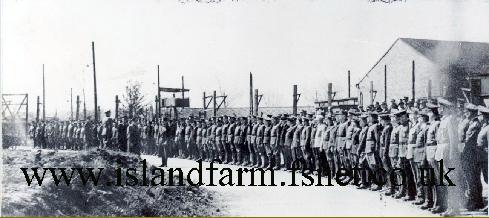 |
| 1946 German Officers line up as a salute to Rundstedt as he departs for the Nuremburg War Trials |
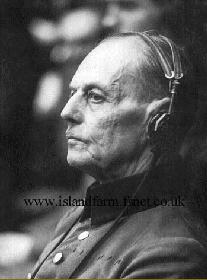 |
| Rundstedt's testimony at the Nuremberg Trials - 12 August 1946 |
The judgment of the Court was delivered on 30 September and 1 October 1946. Of the twenty-one defendants personally present (Martin Bormann was unavoidably detained) three were acquitted:
- Franz von Papen, Chancellor of the Weimar Republic in 1933, before the takeover of Hitler Ambassador to Turkey afterwards, and imprisoned by Hitler in the closing months of the war as untrustworthy;
- Hans Fritsche, National Socialist radio propagandist;
- Hjalmar Schacht, erstwhile Director of the German Reichs-Bank, internationally esteemed financial expert, and, together with Papen, supporter of the "strongman" Hitler in the waning days of the Weimar Republic, similarly subject to change of mind, and similarly imprisoned.
Three defendants received life sentences:
- Rudolf Hess, once Second-in-Command to Hitler and best known for his "Peace flight" to Britain (1941);
- Walter Funk, National Socialist economic organizer
- Erich Raeder, Grand Admiral of the former German Fleet and advocate of a stronger surface fleet before 1939, cautioning against military involvement with Britain.
Four received jail sentences of ten to twenty years:
- Baldur von Schirach, National Socialist youth leader;
- Albert Speer, expert Organizer of armaments production (although once an architect by trade);
- Constantin von Neurath, Foreign Minister before 1938 and Reichsprotektor of Bohemia Moravia prior to 1942;
- Karl Dönitz, capable submarine admiral and head of the German Reich in its last days in 1945.
The remaining twelve accused were condemned to death, among them the top leaders of the National Socialist party-and-state machine:
- Hermann Wilhelm Göring,
- Joachim von Ribbentrop,
- Wilhelm Keitel,
- Ernst Kaltenbrunner,
- Hans Frank,
- Wilhelm Frick,
- Alfred Rosenberg,
- Julius Streicher,
- Fritz Sauckel,
- Alfred jodl,
- Arthur Seyss-Inquart
- Martin Bormann.
In addition, the following groups and organizations were declared criminal:
- the SS and SD (Schutzstaffel, Sicherheitsdienst -- Himmler's private army and security police);
- the SA (Sturmabteilung - the storm troopers powerful during the dusk of the Weimar Republic, under their leader Roehm, who was liquidated by Hitler in 1934);
- the Gestapo (Geheime Staatspolizei -- the secret police under the wing of the SS and Himmler);
- the Leadership Corps of the National Socialist Party. The Reich Cabinet and the General Staff and High Command of the German Armed Forces (OKH and OKW -- Oberkommando des Heeres, Oberkommando der Wehrmacht) were, as corporate entities, acquitted of the charge of criminality.
- In the British Zone, military tribunals tried 937 persons, acquitted 260, and sentenced 230 to death.
- In the U.S. Zone, 177 persons were tried by military tribunals, 24 were sentenced to death, 35 acquitted.
- In the small French Zone, military courts tried 2,107 people, condemned 104 to death, acquitted 404, and gave 1,235 shorter prison terms.
In Western Europe, military trials were also conducted by the Netherlands (35), Norway (11), Canada (5), and Greece (1). Additionally, the three big Western powers tried German defendants in countries where the latter had held official positions. Thus, Generals von Mackensen, Maelzer and Kesselring were tried in Rome and Venice, respectively, by British authorities, while General Dostler was subjected to a similar process by the United States in Rome. In addition, twelve subsequent Nürnberg trials were carried out from January 1947 to October 1948. In these, a motley and highly divergent collection of defendants was tried; many sentenced to death or to long prison terms.
These "lower" Nürnberg proceedings were conducted by the United States Government against the following groups:
- The Concentration Camp Medical Case,
- The Milch Case against Air Field Marshal Milch, a deputy of Göring,
- The justice Case against a number of high-ranking judges of the Third Reich,
- The SS Case against some surviving leaders of the SS,
- The Flick Case against this steel magnate and five associated industrialists,
- The Farben Case against twenty-four officials of the Interessen-Gemeinschaft Farben chemical trust,
- The Hostages Case against army officers charged with violating the customs of war; let it be briefly noted here that some of these twelve generals, among them Speidel, Lanz, and Foertsch, had actively conspired against Hitler and vainly tried to get in touch with Allied leaders since 1942/43
- The RUSHA Case against National Socialist "Race Administrators,"
- The Einsatzgruppen Case against leaders of anti-partisan commandoes,
- The Krupp Case against this industrial leader and eleven of his collaborators,
- The Ministries Case against chief administrators in the war economy and the foreign office,
- The High Command Case against fourteen high-ranking generals of the Army and Air Force.
August 1948:
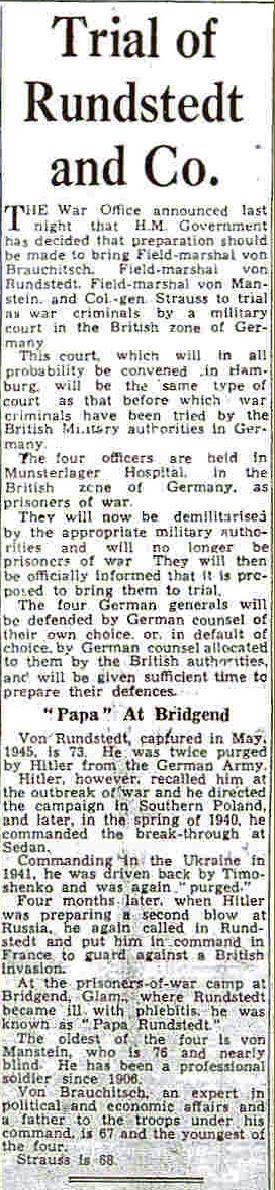
The War Office announced last night that H.M. Government has decided that preparation should be made to bring Field-marshal von Brauchitsh, Field-marshal von Rundstedt, Field-marshal von Manstein and Col-gen Strauss to trial as war criminals by a military court in the British zone of Germany. This court, which will in all probability be convened in Hamburg will be the same type of court as that before which war criminals have been tried by the British Military authorities in Germany. The four officers are held in Munsterlager Hospital, in the British zone of Germany, as prisoners of war. They will now be demilitarised by the appropriate military authorities and will no longer b prisoners of war. they will then be officially informed that it is proposed to bring them to trial. The four German generals will be defended by German counsel of their own choice or, in default of choice, by German counsel allocated to them by the British authorities and will be given sufficient time to prepare their defences.
"Papa" At Bridgend
Von Rundstedt, captured in May 1945, is 73. He was twice purged by Hitler from the German Army. Hitler, however, recalled him at the outbreak of war and he directed the campaign in Southern Poland, and later, in the Spring of 1940, he commanded the break-through at Sedan. Commanding in the Ukraine in 1941, he was driven back by Timoshenko and was again "purged". Four months later, when Hitler was preparing a second blow at Russia, he again called in Rundstedt and put him in command in France to guard against a British invasion. At the prisoners-of-war camp at Bridgend, Glam, where Rundstedt became ill with phlebitis, he was known as "Papa Rundstetd". The oldest of the four is von Manstein, who is 76 and nearly blind. He has been a professional soldier since 1906. Von Brauchitsch, an expert in political and economic affairs and a father to the troops under his command, is 67 and the youngest of the four. Strauss is 68
September 1948:
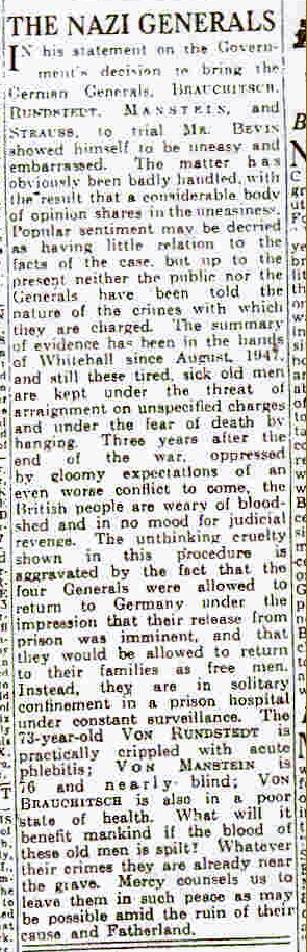
Western Mail Newspaper: 23rd September 1948
THE NAZI GENERALS
In his statement on the Government's decision to bring the German Generals. Brauchitsch, Rundstedt, Manstein and Strauss to trial Mr. Bevin showed himself to be uneasy and embarrassed. The matter has obviously been badly handled, with the result that a considerable body of opinion shares in the uneasiness. Popular sentiment may be decried as having little relation to the facts of the case, but up to the present neither the public nor the Generals have been told the nature of the crimes with which they are charged. The summary of evidence has been in the hands of Whitehall since August 1947, and still these tired, sick old men are kept under the threat of arraignment on unspecific charges and under the fear of death by hanging. Three years after the end of the war, oppressed by gloomy expectations of an even worse conflict to come, the British people are weary of bloodshed and in no mood for judicial revenge. The unthinking cruelty shown in this procedure is aggravated by the fact that the four generals were allowed to return to Germany under the impression that their release from prison was imminent, and that they would be allowed to return to their families as free men. Instead, they are in solitary confinement in a prison hospital under constant surveillance. The 73-year-old Von Rundstedt is practically crippled with acute phlebitis; Von Manstein is 76 and nearly blind; Von Brauchitsh is also in a poor state of health. What will it benefit mankind if the blood of these old men is spilt ? Whatever their crimes they are already near the grave. Mercy counsels us to leave them in such peace as may be possible amid the ruin of their cause and Fatherland.
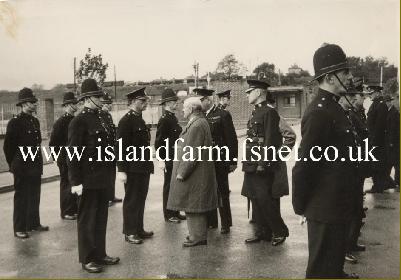
Lord Oaksey's visit to Bridgend October 1948:
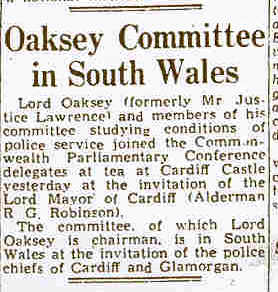 |
| Western Mail Newspaper: 15th October 1948 |
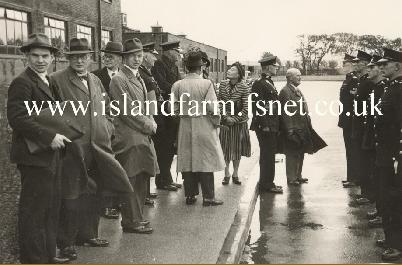 |
Lord Oaksey Outside the South Wales Police Heads Quarters
(formerly the main entrance of the Royal Ordnance Factory known as the Admiralty)
 |